Galvanic isolation means there is no electrically conductive path between two systems. Fiber optics provides it as a side effect of how it works: light carries the signal, glass carries the light, and glass conducts no current.
It sounds like an electrical engineering footnote. In practice it is often the reason fiber is specified at all – ahead of bandwidth, ahead of distance – because it solves four different problems with one property.
Four problems, one property
Two buildings rarely share the same ground potential, and two substations never do. A copper link between them carries equalising current driven by that difference. The current corrupts data, heats connectors and, in the worst case, destroys the interface at one or both ends. It is a persistent fault that looks intermittent, which makes it expensive to diagnose. Fiber breaks the loop entirely: there is no conductor, so there is no current to flow.
Lightning strikes and switching operations put large, fast voltage spikes onto conductors. A surge follows every conductive path available to it, which is how a strike on one building destroys equipment in another. An isolated link is a dead end – the surge reaches the transceiver and stops, because there is nothing beyond it to conduct into.
A copper cable is an antenna in both directions: it picks up noise from its surroundings and radiates its own signal outward. In industrial environments the pickup is usually the problem – motor drives and switchgear produce enough noise to corrupt data on a nearby cable. In hospitals it is frequently the reverse: equipment near sensitive diagnostic instruments must not radiate into them. Fiber neither picks up nor emits.
A conductor leaks its signal electromagnetically, and can be tapped inductively – without breaking the cable, without interrupting service, without leaving a trace. Tapping a fiber requires physically intercepting the glass, which is difficult and shows up as measurable signal loss. That difference turns galvanic isolation from an EMC property into a security property.
Why this matters for TEMPEST
The fourth point is why fiber appears throughout TEMPEST and RÖS system design rather than only in the network diagram.
In a certified installation the boundary of the protected zone is where the risk lives. Any copper conductor crossing it – a network cable, a USB lead, a video cable, even the mains earth – can carry emissions out of the room to a receiver connected further along. Filtering handles what must remain conductive, such as power. Everything else is converted to fiber precisely so that it carries nothing to intercept.
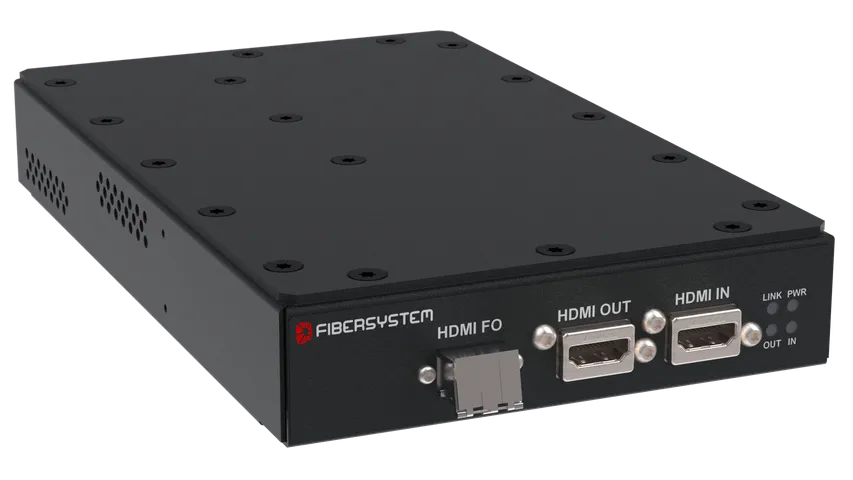
This is why certified workplaces use fiber optic connections for display, USB and network links between the protected desk and the equipment room. It is not about bandwidth over a three-metre run. It is about not putting a wire through the wall.
Where it decides the design
Data diodes combine one-way transfer with full isolation. The two properties reinforce each other: the diode removes the logical return path, the fiber removes the electrical one.
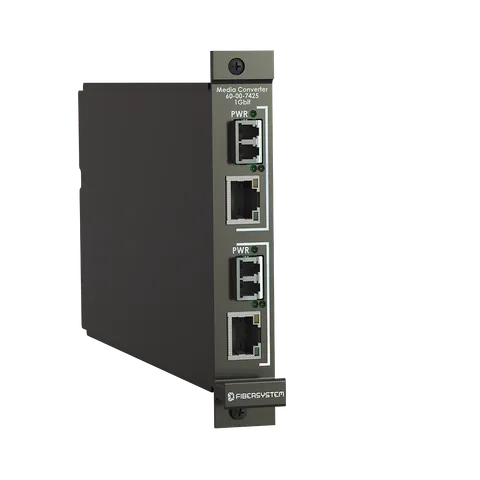
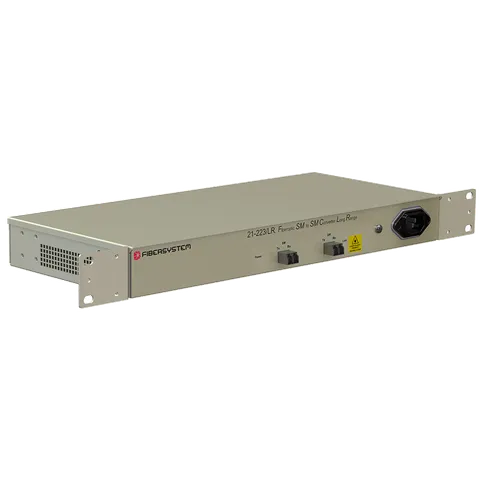
Converters and extenders carry links up to 250 km without introducing a conductive path between the endpoints.
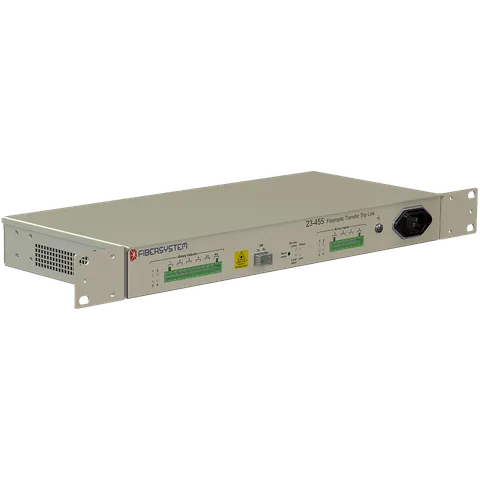
Protective relays sit in the single worst electrical environment in normal industry – high voltage, large ground potential rise, severe transients during exactly the fault conditions the relay exists to handle. Teleprotection and trip links covers the specific requirements, and IEEE C37.94 is the standard written for that interface.
Interference-free links where sensitive instrumentation and noisy machinery share a building. See healthcare solutions.
The limits worth knowing
Galvanic isolation is not a general security control, and it is worth being precise about what it does not do.
It does not encrypt. A fiber link carries plaintext unless something else encrypts it; the difficulty of tapping is a practical obstacle, not a cryptographic one.
It does not isolate logically. Two networks joined by a fiber converter are still joined. Isolation here is electrical, not a security boundary – that is what a data diode or a firewall is for.
And it applies to the fiber, not to the box. A converter with copper on one side and fiber on the other provides isolation across the optical span, but the copper segment retains every property discussed above. Where the isolation boundary sits is a design decision, and it should be a deliberate one.
Every fiber product in the catalogue delivers isolation by construction. The remaining question is only which interface and which distance – which comes down to singlemode or multimode.