Both protect the boundary between networks, and they are frequently compared as if they were alternatives. They are not. They belong to different security classes, and the difference is not one of degree.
The fundamental difference
A firewall is software. It inspects traffic and applies rules about what may pass, in both directions. Rules can be misconfigured, software can be exploited, and management interfaces can be attacked. Virtually every firewall breach traces back to one of those three, and none of them is a defect that a better firewall eliminates – they are properties of a device that makes decisions.
A data diode is hardware. The sending side physically has only an optical transmitter, the receiving side only a receiver. Reverse traffic is not forbidden – it is impossible, in the same sense that a light bulb cannot absorb light. There is no rule set to audit, no management plane to attack, and no configuration state that can drift.
The distinction that matters is what you have to trust. With a firewall you trust a configuration, a codebase and an administrator, continuously. With a diode you trust a physical construction, once, and you can inspect it.
Why “impossible” is worth paying for
Assurance is the real currency here. A firewall’s guarantee is conditional: nothing gets in provided the rules are right, the software has no relevant vulnerability, and no one has changed anything they should not have. Each condition is reasonable on its own. Together, maintained across years and staff changes, they are where breaches come from.
A diode’s guarantee has no conditions attached. That is why accreditation regimes treat the two differently, and why a diode can be part of a documented cross-domain solution in a way a firewall generally cannot. The property being certified is demonstrable rather than operational.
When each is right
| Need | Tool |
|---|---|
| Filter general two-way office traffic | Firewall |
| Guarantee nothing can enter a protected network | Data diode |
| Export logs or measurements from a critical system | Data diode |
| Segment networks of equal trust | Firewall |
| Certifiable one-way guarantee for accreditation | Data diode |
| Inspect content for malware | Firewall or dedicated inspection |
In practice, critical environments use both. Firewalls handle day-to-day segmentation, where traffic must flow in both directions and rules genuinely are the right tool. Diodes sit at the small number of boundaries where compromise is unacceptable: control networks, classified domains, evidence and log collection.
Treating them as competitors leads to the wrong conclusion in both directions – a diode in front of an office network is useless, and a firewall in front of a control system is a decision to accept a risk that did not have to be accepted.
What a diode costs you
Being honest about the trade-off is more useful than selling the guarantee.
TCP requires acknowledgements travelling back, and across a diode they cannot exist. UDP, Syslog, broadcast NTP and SNMP traps cross natively; everything else needs middleware on both sides or a bidirectional pair. One-way protocols covers this in detail.
The receiver cannot ask the sender to slow down. A sender that bursts above the link rate loses data, silently. Links must be sized for the peak.
There is no acknowledgement to tell you the data arrived. Verification has to be designed into the flow – checksums, sequence numbers, a heartbeat – rather than assumed from a successful connection.
A diode faithfully exports whatever the sending side transmits, including malformed or malicious data. If the protected network is compromised, the diode does not notice. Inspection, where needed, is a separate function on one side.
None of these is a reason not to use a diode where a diode belongs. They are reasons to design the flows deliberately instead of dropping one in and expecting the network to behave as before.
The common mistake
The most frequent error we see is installing a diode in the wrong direction – or rather, discovering afterwards that the requirement was never only outbound.
A control network exports telemetry: outbound diode, correct. Six months later someone needs to push a configuration update in. The diode is not an obstacle to be worked around with a temporary bypass; the requirement has changed, and a bypass reintroduces exactly the path the diode was installed to remove. Either the update flow is handled out of band, or the design moves to a bidirectional pair – two independent one-way paths, each still hardware-enforced.
Deciding this before installation is considerably cheaper than deciding it after.
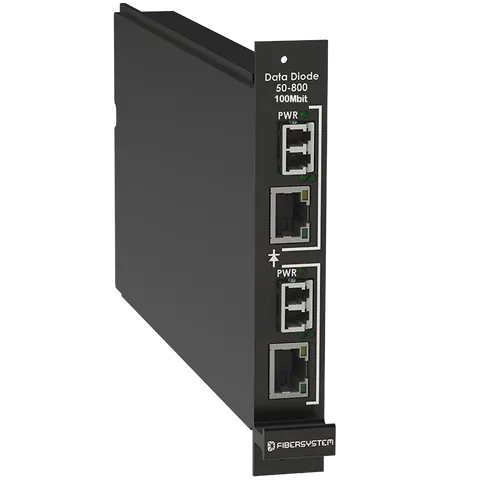
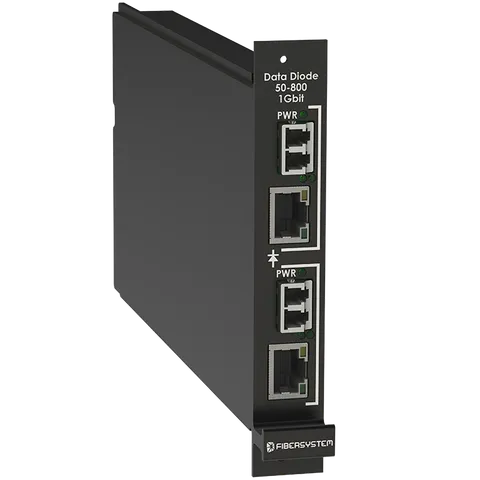
Fibersystem builds data diodes from 100 Mbit upward – stand-alone, rack module, rugged and HDMI variants, in multimode and singlemode, with TEMPEST Level A and RÖS U1 certified options. See also: what is a data diode.