Optical fiber comes in two families, and the difference is physical rather than a matter of quality. Multimode fiber has a wide core in which light travels along many paths at once. Singlemode has a core narrow enough that only one path exists. Everything else – reach, cost, which transceivers fit, which one belongs in a given installation – follows from that one distinction.
The physical difference
| Multimode | Singlemode | |
|---|---|---|
| Core diameter | 50 or 62.5 µm | 8–10 µm |
| Wavelength | 850 nm, sometimes 1300 nm | 1310 nm, 1550 nm |
| Typical reach | Up to a few hundred metres | Tens to hundreds of kilometres |
| Transceiver cost | Lower | Higher |
| Jacket colour (convention) | Aqua or orange | Yellow |
In a wide core, light entering at different angles takes paths of different lengths. All of it arrives, but not at the same instant, and a pulse that started sharp arrives smeared. This is modal dispersion, and it is what limits multimode reach: push the distance far enough and consecutive pulses overlap until the receiver can no longer tell them apart.
A singlemode core is narrow enough that only one path exists, so the smearing does not occur. That is why singlemode carries tens or hundreds of kilometres where multimode manages hundreds of metres.
Cost lives in the transceiver, not the cable
A common assumption is that singlemode is expensive. The fiber itself is not – prices are comparable, and singlemode is often cheaper by the metre.
The cost is in the optics. Launching light into an 8 µm core requires a precise source, typically a laser, with tighter alignment tolerances. Multimode’s wide core accepts light from cheaper sources and tolerates more mechanical imprecision in connectors and splices.
For a link inside a building, multimode is usually the sensible choice: shorter runs, cheaper transceivers, easier termination. For anything reaching between buildings or across a site, singlemode wins on reach and stops being a cost question.
Where this matters in a secure installation
Fiber is not chosen only for bandwidth in this field. It is chosen because it carries no electrical connection – which brings two properties that copper cannot offer at any price.
There is no conductive path between the two ends, so no ground loops, no surge propagation and no electrical fault travelling from one system into another. In substations and industrial plants this is often the primary reason for fiber, ahead of bandwidth. Why galvanic isolation matters covers this in full.
A fiber does not radiate the signal it carries and cannot be tapped by induction from outside. In a TEMPEST-protected environment that is decisive: copper leaving a protected zone carries emissions with it, fiber does not. This is why certified workplaces use fiber for display, USB and network connections wherever a wire would otherwise cross the boundary.
Neither property depends on which fiber type you choose. Both singlemode and multimode provide them. The choice between them remains a question of distance and budget.
Choosing in practice
Multimode. Cheaper transceivers, and the distance is well within reach at 1 Gbit and above.
Either can work; singlemode is the safer choice if the link may need higher speeds later. Multimode reach shrinks as data rate rises – a run that carries 1 Gbit comfortably may not carry 10 Gbit at all.
Singlemode, without much deliberation.
Singlemode in almost every case, because the distances involved are long and the reliability requirement is absolute. Teleprotection and trip links covers the specific requirements there.
The most common real-world constraint. If fiber is already in the ground, its type decides yours. Converters exist to bridge between the two, and are a normal part of an installation where a multimode building link meets a singlemode site backbone.
Connectors are a separate decision
Fiber type and connector type are independent, and mixing them up causes ordering mistakes. LC is the common small-form connector on modern equipment; SC is larger and older but still widespread; MPO carries multiple fibers in one ferrule and appears where many links share a path. A singlemode LC connector and a multimode LC connector look nearly identical and will physically mate – while carrying nothing usable. Colour convention helps; labelling helps more.
What we build
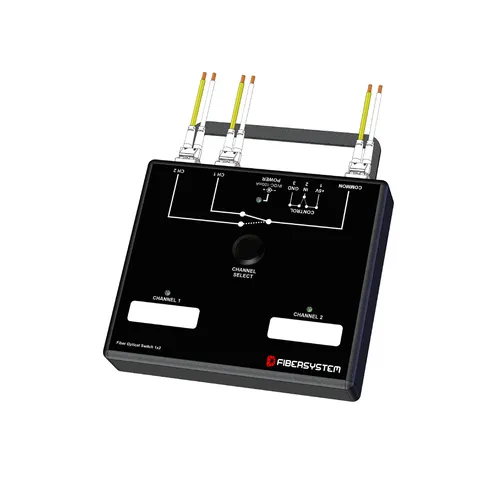
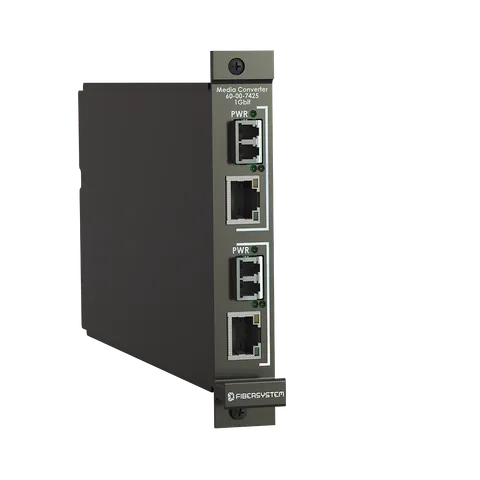
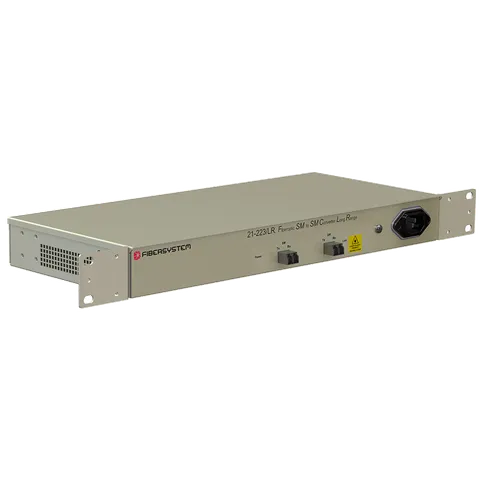
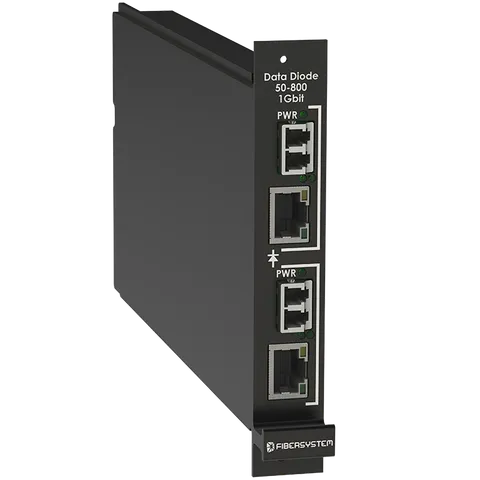
Fibersystem builds converters, extenders, optical switches and data diodes in both multimode and singlemode variants, with LC, SC and MPO connectors, including TEMPEST Level A and RÖS U1 certified versions. If you are unsure which type an existing installation uses, send us the details – it is a five-minute question to answer and an expensive one to guess at.