Questions and answers
The questions buyers actually ask
Minimum quantities, export control, tender routes, certification levels and who picks up the phone. If your question is not here, ask it – the list grows from real conversations.
Buying from Fibersystem
Do you sell to civilian organisations, or only to defence?
Both. Defence is our largest sector, but the same equipment protects hospitals, power grids, industrial control systems, laboratories and financial institutions. Nothing in the catalogue is restricted to military buyers as such — what governs a sale is the destination country and the applicable export control rules, not the sector you work in.
Is there a minimum order quantity?
No. We deliver single units as readily as series of a thousand. For custom development the economics change — a bespoke product carries a development cost that has to be carried by the series — but we will tell you plainly whether a small series is sensible before you commit to anything.
Can you deliver outside Sweden?
Yes. Our equipment is installed in a number of countries. Deliveries outside Sweden are subject to export control, and TEMPEST-certified equipment in particular is regulated. Tell us the destination country early — it is the single fastest way to establish what is possible, and it is why country is a required field on the quote form.
What are your lead times?
It depends on the product and the quantity. Stock items ship quickly; TEMPEST-certified equipment is generally built to order, and a full workplace or conference room is a project with a plan. We state a concrete lead time in the quote rather than a general promise here.
Do you provide equipment on loan for evaluation?
In some cases, for established customers and where certification permits it. Ask in your request and describe what you need to verify — often a test report or a reference installation answers the question faster than a loan unit.
Procurement and security
Can you take part in a public tender under LOU or LUFS?
Yes. We respond to published tenders, deliver through framework agreements and handle direct awards. See procurement support for what we can supply as tender documentation, and tell us in your request which route you are on — it changes what we send you.
Can you sign a security protection agreement (SUA)?
Yes. As a main supplier to the Swedish Total Defence we work under security protection agreements. The process is governed by the Protective Security Act and is driven by the procuring authority — we take part in it, we cannot initiate it for you.
Will you sign an NDA before we discuss technical details?
Yes, and it is often the sensible order of business. Tick the confidentiality box on the quote form and we will send an agreement before the technical conversation starts.
Do your staff hold security clearance?
Where an assignment requires it, yes. Clearance is granted per person and per assignment through the procuring authority, so the specific answer depends on the engagement. Raise it early — it affects the timeline more than most people expect.
Can we get pricing for a budget estimate before a tender?
Yes. Choose “Budget figure ahead of a tender” as your required delivery on the quote form. We will be explicit about what is a firm price and what is an indication.
Technical
What is the difference between TEMPEST Level A and Level B?
They are protection levels in the NATO standard SDIP-27, matching the Swedish RÖS levels U1 and U2. Level A is the strictest and is intended for the most exposed environments; Level B protects a zone that already has some physical separation. The levels are explained here.
Is a data diode the same as a firewall?
No. A firewall is software-configured and can be misconfigured, bypassed or exploited. A data diode enforces direction in hardware — there is no return path to configure wrongly. The comparison in full.
Can equipment be certified after we have bought it?
No. TEMPEST and RÖS certification applies to a specific product in a specific configuration, tested by an accredited laboratory. Modifying a certified unit — or certifying an existing commercial one after the fact — voids or precludes the approval. That is why certified equipment is built as certified equipment from the start.
The product I need does not exist. What now?
That is a project, not a dead end. Design, development, certification and production happen in one building in Stockholm, and much of the current catalogue began as one customer’s requirement. See custom development.
Do you supply installation and commissioning?
We supply the equipment and the documentation needed to install it correctly, and we support the installation team. For complete workplaces and conference systems we take a larger role — describe the environment in your request and we will say what we can cover.
Support and lifecycle
How long are products supported?
Long-lived installations are the norm in this field, and we plan for it. Support and spare parts availability are agreed per product family rather than by a blanket rule — ask about a specific product and we will give you the actual answer.
Who answers a technical question?
An engineer. Support, development and production sit in the same building in Bromma, so a question about an interface or an installation problem reaches someone who has had that unit on the bench. Working days 8–17 CET, on +46 8 564 828 80.
Where can I find datasheets and certificates?
Every downloadable document is listed on the documents page, with file type and size. Certification papers that are not published — test reports, specific approvals — are available on request.

Next step
Still unanswered?
Describe the situation and an engineer answers – normally within two working days, and without a sales script in between.
Verified credentials
All certifications- NATOCertified TEMPEST supplierSDIP-27 · Level A & B
- Swedish Armed ForcesM-numbered equipmentMain supplier, Total Defence

- Government of SwedenSupplier to Swedish authoritiesPolice · FMV · FOI

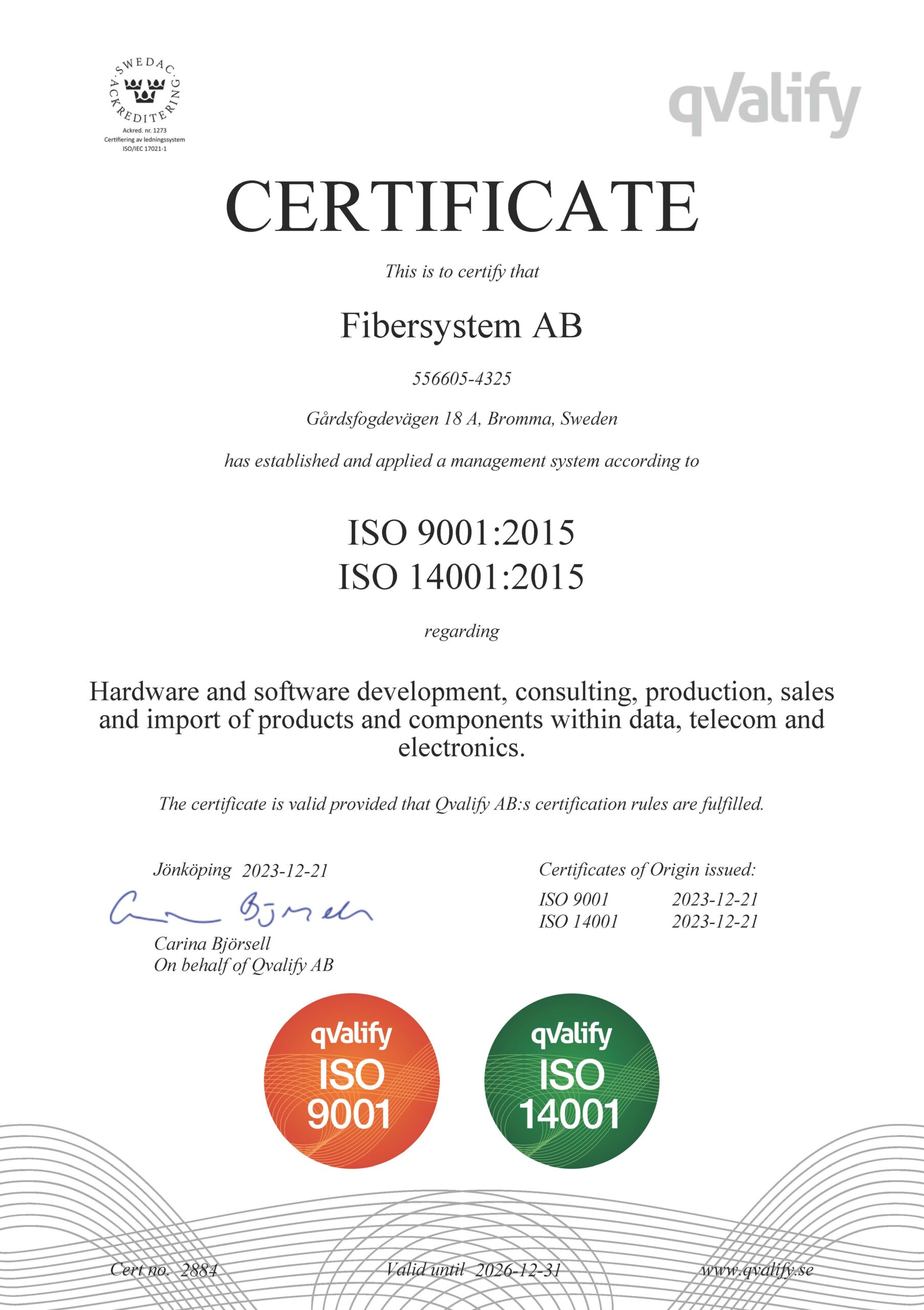
- ISO 9001 14001ISO certifiedQuality & environmentDownload certificate (JPG)
- SOFFDefence industry memberExport control frameworks

- Made in SwedenDesigned & built in StockholmSecure supply chain