Procurement support
Buying certified equipment, without surprises late in the process
Most of our customers buy under public procurement rules. This page sets out the routes we deliver through, what we can supply as tender documentation, and how to word a requirement so that it cannot be met by equipment that only claims to be certified.
Routes
How we can be procured
Direct award
When: Below the threshold value, or when only one supplier can meet the requirement.
What we supply: Quote, technical specification and delivery terms. Fastest route to a working installation.
Published tender (LOU / LUFS)
When: Above the threshold. LUFS applies to defence and security procurement specifically.
What we supply: Tender response, certification evidence, references and the documentation the contracting authority asks for.
Call-off from a framework agreement
When: Your organisation already has a framework covering secure IT equipment.
What we supply: Delivery through the framework holder. Tell us which agreement and we will confirm the route.
Security-protected procurement (SUA)
When: The assignment involves classified information or protection-worthy activity.
What we supply: We work under security protection agreements as a main supplier to the Swedish Total Defence. The process is driven by your authority; we take part in it.
Writing the requirement
Five clauses that keep uncertified equipment out
The most common problem we see is a specification that describes the function but not the approval. It lets a cheaper, uncertified product qualify on paper — and the gap is discovered after delivery, when it is expensive.
Certification level
State the required level rather than a product name — "TEMPEST Level A in accordance with SDIP-27, corresponding to RÖS U1" leaves no room for a cheaper substitute that is not certified.
Evidence of certification
Require certification issued by an accredited laboratory, and require the certificate to be presented with the tender. A datasheet claim is not a certificate.
Country of design and manufacture
If supply-chain control matters, say so explicitly. Design, development and production in one country is a requirement that can be verified.
Lifecycle and spare parts
State the required support period and spare parts availability. Secure installations outlive ordinary IT procurement cycles.
M-number where applicable
For Swedish Armed Forces deliveries, require the equipment to carry an M-number. It is the approval that matters in that context.
Documentation
What we can supply with a tender
- Datasheets and technical specifications
- Certification evidence, TEMPEST Level A/B and RÖS U1/U2
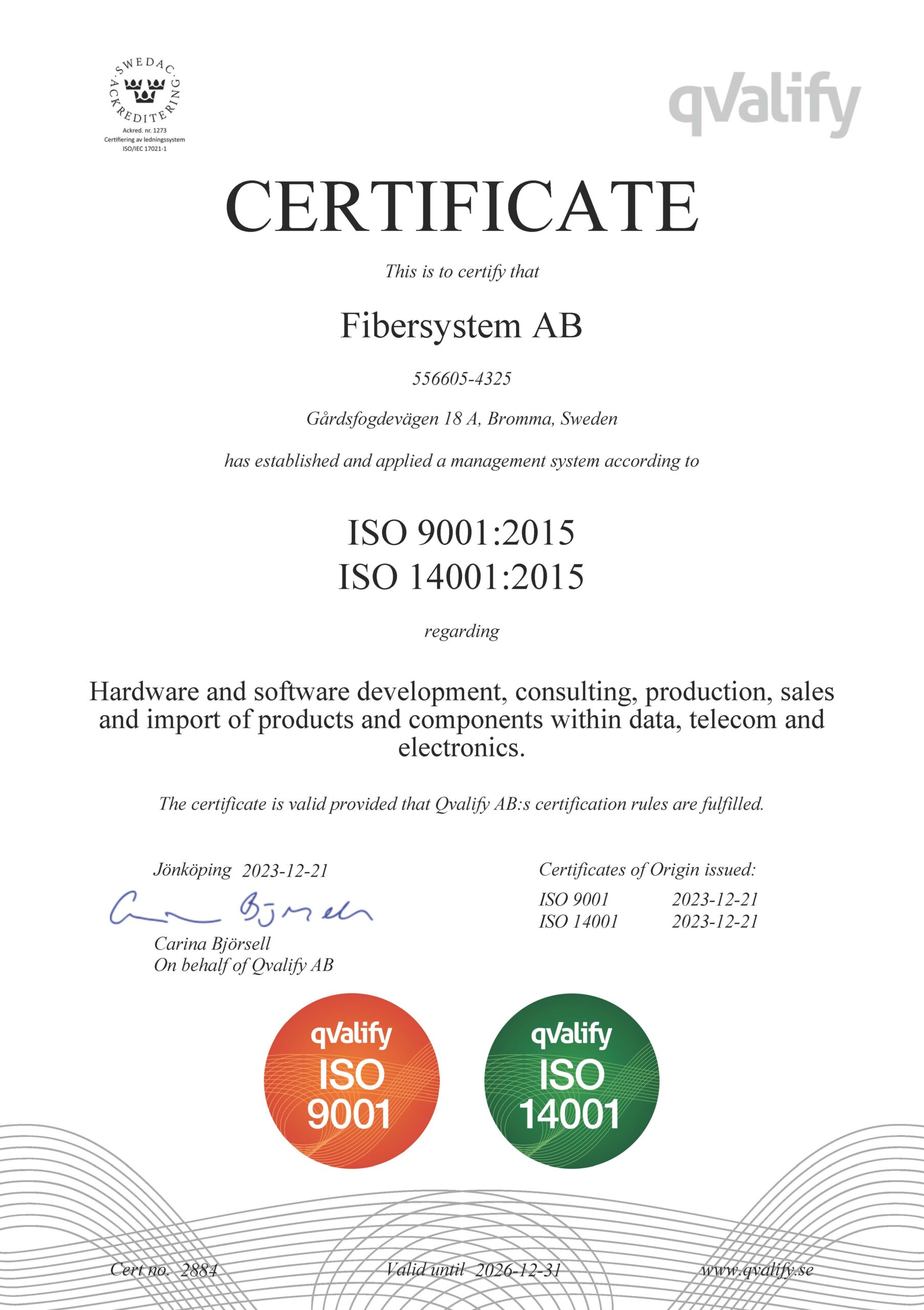
- ISO 9001 and ISO 14001 certificates
- Conflict minerals declaration and code of conduct
- M-numbers where the equipment carries one
- References, on request and subject to customer consent
Test reports and specific approvals are not published openly. Ask for them in your request and state the tender they relate to.
Export control
Destination decides what is possible
TEMPEST-certified equipment is export-controlled. The destination country — not the sector you work in — governs what may be delivered and what approvals are required. Tell us the country at the start of the conversation rather than at the end; it is the single fastest way to establish what is possible, and it is why country is a required field on the quote form.

Next step
Send us the requirement specification
We will tell you what we can meet, what needs rewording, and what documentation to expect – before you publish it.
Verified credentials
All certifications- ISO 9001 14001ISO certifiedQuality & environmentDownload certificate (JPG)
- NATOCertified TEMPEST supplierSDIP-27 · Level A & B
- Swedish Armed ForcesM-numbered equipmentMain supplier, Total Defence

- Government of SwedenSupplier to Swedish authoritiesPolice · FMV · FOI

- SOFFDefence industry memberExport control frameworks

- Made in SwedenDesigned & built in StockholmSecure supply chain