When a protective relay detects a fault, the trip command must reach the far substation now – reliably, unfalsifiably, and regardless of what the fault itself is doing to the electrical environment. That is teleprotection, and it is among the most demanding communication tasks in any power grid.
Two failure modes matter, and they pull in opposite directions. A command that fails to arrive leaves a fault energised, with everything that follows. A command that arrives when it should not opens a healthy line, which is its own kind of incident. A trip link has to be both dependable and secure against false operation, and the balance between them is a protection engineering decision rather than a communications one.
Why copper pilot wires fail exactly when needed
Traditional pilot wires run copper between stations. But a grid fault creates precisely the conditions copper handles worst.
Fault current flowing into the earth grid raises the potential of one substation relative to another – by kilovolts, briefly. A copper pair connecting them now has that difference across it.
The fault current produces a rapidly changing magnetic field, and every nearby conductor picks up a corresponding voltage.
Arcing, breaker operation and switching produce broadband noise at exactly the moment the link is carrying its most important message.
The medium fails when the message matters most. Mitigations exist – isolating transformers, surge arresters, careful earthing – and they are all attempts to manage a problem that fiber does not have.
Optical trip links remove it instead of mitigating it: fiber carries no current, has no galvanic path, picks up no interference, and cannot be tapped at a distance. Why galvanic isolation matters covers the property in general terms; in a substation it is the whole argument.
Choosing a trip link
Three parameters decide.
The link interfaces the relay’s binary signal, typically 110 V or 220 V systems. This is the contact voltage the relay presents, not the supply voltage, and getting it wrong means the link and the relay do not talk.
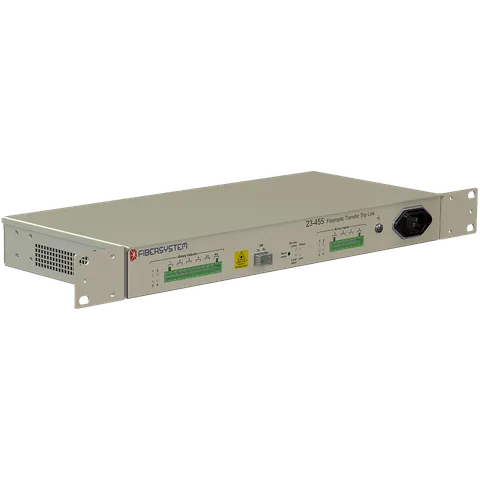
How much fiber loss the link tolerates, which is what determines reach. Fibersystem’s range covers 10 dB for roughly 2 km, 39 dB for roughly 120 km, and SFP-based versions at 50 dB reaching up to 240 km.
The budget has to cover more than distance. Every splice, every connector pair and every patch panel adds loss, and fiber ages. Size the budget against the measured loss of the actual route with margin, not against the map distance — a 100 km link through six patch panels is not a 100 km problem.
Direction and confirmation. Fibersystem’s trip links are bidirectional, so a make-or-break contact at the far end can be fed back to verify that the command was executed. That confirmation is what turns “we sent it” into “it operated”, and it is worth having.
Where trip links sit in the wider picture
A trip link is a point-to-point signal path, and it is deliberately simple: a contact closes here, a contact closes there. That simplicity is a feature — there is very little to fail and very little to configure.
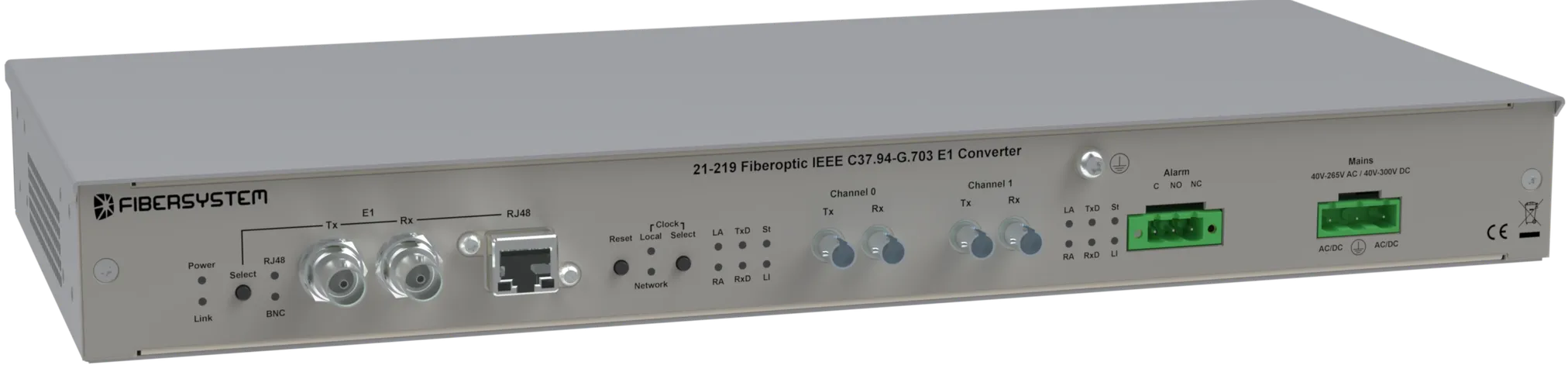
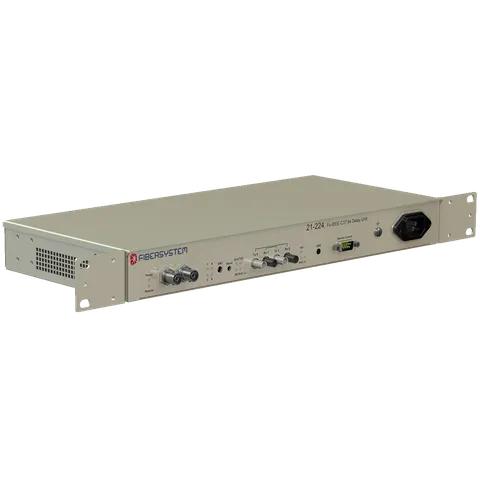
Relays that speak a standard digital interface use IEEE C37.94 instead, carried onward over the utility’s E1, SDH or Synchronous Ethernet network. That path offers more channels and better integration with the wider communications estate, at the cost of more equipment in the chain and a latency budget to manage.
Both approaches coexist in most utilities. Direct trip links for the critical point-to-point protection, multiplexed C37.94 where the traffic shares the network with everything else.
Beyond the trip command
The same fiber principles protect the rest of the substation.
Data diodes export SCADA and telemetry one way, so process data reaches the operations centre while the control network stays unreachable from it — the one-way protocols used there are the ones utilities already run.
Galvanically isolated converters handle everything else crossing the station boundary, for the same reasons the trip link does.
See the trip link family – 110 and 220 V, 10 to 50 dB, 2 to 240 km – and the OT protection application for how the pieces fit together in a substation.