Application areas
Secure & isolated links
Fiber optic transmission with total galvanic isolation. Converters, extenders and switches carry your signals between sites and substations, safe from interception.
- Products used
- 5
- Examples
- 3
A copper link carries interference, ground faults and eavesdropping risk along with the signal. A fiber link carries none of them.
The application
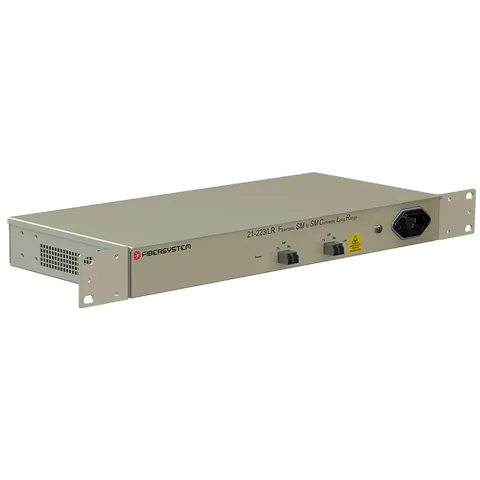
Fibersystem’s converters, extenders and optical switches give you galvanically isolated, interception-resistant links for Ethernet, serial, G.703, IEEE C37.94 and E1 over distances up to 250 km. The modular 19-inch rack system houses every function. The optical switches provide a purely physical signal path with no data plane to attack.
Typical deployments: links between security domains and buildings, teleprotection in power grids, interference-free communication in hospitals and industry.
Where it is used
Process industry
Ground potential differences across a site are what break copper, and what fiber removes.
The same as water, at a larger scale: big motor drives, arc furnaces, welding, and a site earth that is common on paper and not in reality. Here fiber is often chosen for the galvanic isolation alone, not for the distance.
The installed fiber is old and mixed. 62.5/125 from the 1990s sits alongside 50/125 from the 2010s in the same containment. Joining them costs about 4.7 dB in one direction and almost nothing in the other. The result is the most confusing fault in the field: a link that works in one direction only.
Link between buildings over public land
The operator’s later cross-connects eat your budget after handover, which is why the acceptance measurement matters.
Two buildings never share an earth potential. And the cable passes ground that somebody else owns and can dig in.
Two things are usually missed. The fiber is leased, which means it is measured by somebody else, with somebody else’s reference and somebody else’s conditions. Ask for an OTDR record and a two-way attenuation measurement at handover, not a datasheet. And the ODF is usually not yours: every time the operator re-patches in their own frame, connector pairs are added to your budget without you being told, so size the budget for it.
Data hall and cross-connect room
Every passive component costs decibels, and a 1x8 switch costs up to 1.5 dB that nobody budgeted for.
In the data hall, fiber is simply the infrastructure. What matters is A/B paths and the ability to move a whole trunk between two destinations without touching a single patch cord.
Insertion loss accumulates quickly. A 1x8 costs up to 1.5 dB typically, and an MPO trunk with two through-connections costs another 1.5–2 dB. On an 850 nm link with perhaps 8 dB of total budget, that is half the budget before the fiber has even started.
How it is built
Galvanic barrier and cross-connect inside the site
Where the isolation boundary sits is a design decision, not an installation detail.
Recommended products
Products for this application

Standard
Fiber Optical Converter IEEE C37.94/E1 over SyncE
- Fiber optic connector
- ST
- Connector
- 120 ohm, RJ48
Product no 60-00-7248
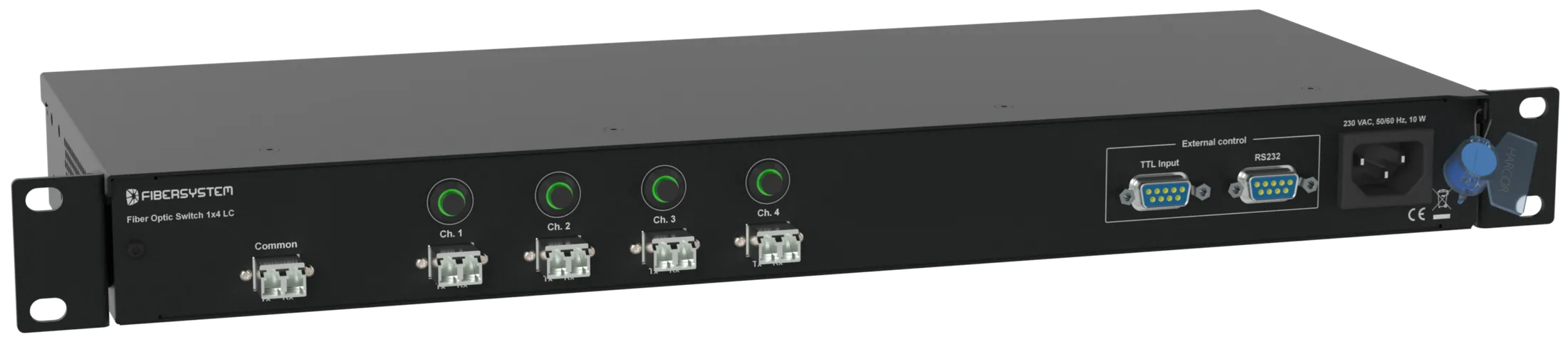
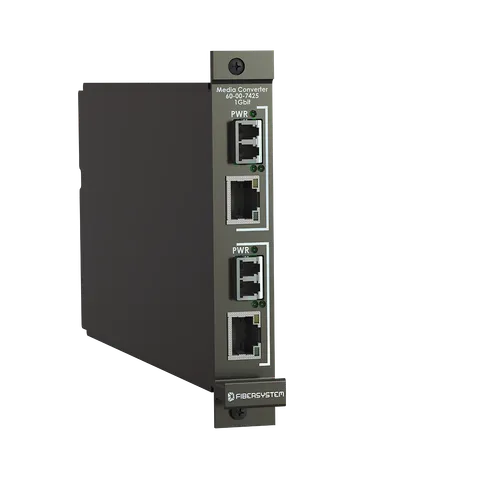
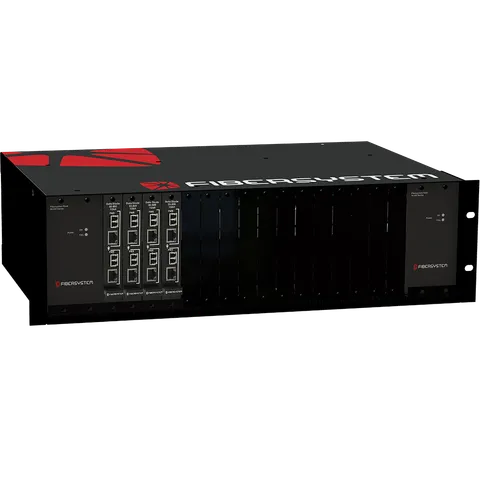
Browse the full range:Industrial Converters and Extenders → · Media Converters → · Fiber Optic Switches → · Rack System →

Next step
Application not on the list?
If the environment you need to secure looks different, our custom development takes it from idea to certified end product.
Verified credentials
All certifications- NATOCertified TEMPEST supplierSDIP-27 · Level A & B

- Swedish Armed ForcesM-numbered equipmentMain supplier, Total Defence

- Government of SwedenSupplier to Swedish authoritiesPolice · FMV · FOI

- ISO 9001 14001ISO certifiedQuality & environmentDownload certificate (JPG)
- SOFFDefence industry memberExport control frameworks

- Made in SwedenDesigned & built in StockholmSecure supply chain