Anyone can print “rugged” on a datasheet. MIL-STD 810G is what turns the word into a verifiable claim: a US military standard defining laboratory test methods for environmental endurance.
The standard does something more subtle than setting a pass mark. It defines methods – reproducible procedures – and leaves the severity to be chosen for the intended environment. That is why a bare reference to the standard says almost nothing, and why the method numbers matter.
The tests behind the word
From the specification of Fibersystem’s rugged product family:
- Low pressure – method 500.5: air transport and operation at altitude
- High and low temperature – methods 501.5 and 502.5: operation at +70 °C, storage down to −46 °C
- Rain and humidity – methods 506.5 and 507.4: outdoor rain, 95 % RH cycling
- Salt fog – method 509.5: 5 % salt concentration for 7 days, for naval and coastal environments
- Vibration and shock – methods 514.5 and 516.6: transport categories, functional shocks in all six directions
- Water and dust ingress – IPX5 and IP4X
Each line names a method because each method is a different question. Salt fog says nothing about vibration; an altitude test says nothing about rain.
Reading a rugged datasheet
Three questions separate real ruggedisation from a thick chassis.
Which methods, at which severity? “MIL-STD 810G tested” means little on its own – the standard contains dozens of methods and each has procedures and severity levels. “Method 516.6, procedure I, 3 shocks per axis per direction” means something specific and can be checked.
Operating or surviving? This is the question most often left ambiguous, and the difference is large. A device tested to survive −40 °C storage may not start at −40 °C. A device tested to operate during vibration is a different product from one tested to still work afterwards. For a field-deployed link, operating is usually what you need and surviving is what is usually quoted.
Is EMC included? Environmental endurance is half the story. A device that dies when a radio transmitter is keyed next to it is not rugged, whatever its casing tolerates. That is MIL-STD 461, a separate standard covering the electromagnetic environment, and it should appear alongside 810G rather than instead of it.
Why it matters more for optical equipment
Ruggedising a passive box is one thing. Ruggedising equipment with optical interfaces adds constraints that are easy to underestimate.
Optical connectors are precision components: an 8 µm singlemode core has to align with another 8 µm core across a mated pair, and vibration, thermal cycling and contamination all attack that alignment. Temperature swings change the mechanical dimensions of everything in the light path. Salt fog reaches connector ferrules that were designed for an office.
This is why a rugged optical product is not an office product in a stronger enclosure. Connector retention, strain relief, sealing at the optical interface and thermal design around the transceiver are all part of it — and why the specification should list the methods rather than gesturing at the standard.
Where rugged equipment is actually used
Continuous vibration, wide temperature range, and in naval environments salt. Method 509.5 is not decoration there.
Equipment that is transported, set up, used and moved again, repeatedly, by people with other priorities.
Substation yards, masts, cabinets without climate control. Here the temperature range and ingress protection do the work, and vibration matters less.
Not a military environment, but often a harsher electrical and mechanical one than an office — and the same test methods provide the evidence.
Choosing a rugged variant where the environment is benign wastes money. Choosing a standard product where it is not produces a failure at the worst possible moment, which is the specific failure mode the standard exists to prevent.
The related standards
- MIL-STD 810G proves the device survives the physical environment.
- MIL-STD 461 proves it coexists in the electromagnetic environment.
- TEMPEST and EMSEC go one step further: not merely low emissions, but emissions carrying no reconstructable information, verified to SDIP-27.
The engineering overlaps considerably – shielding, filtering, careful grounding, controlled cable entry – which is why a manufacturer that masters one tends to master all three.
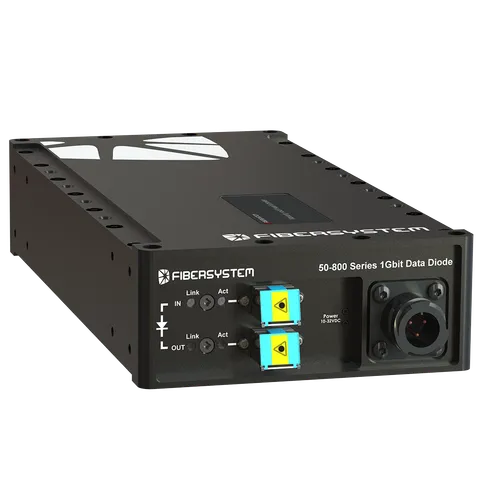
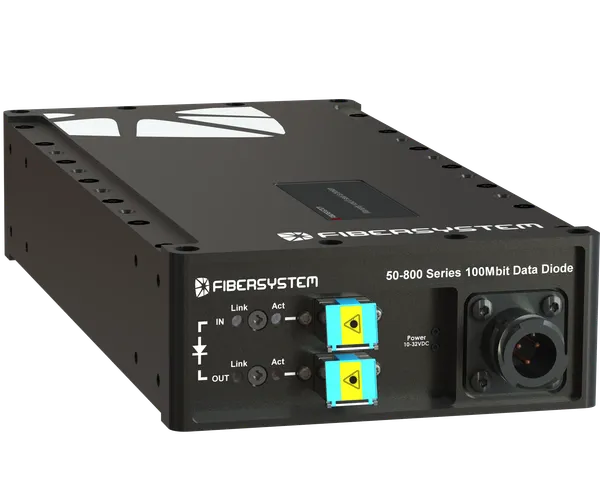
Every Fibersystem rugged product answers the three questions above on its product page and datasheet. See the rugged data diode family, also available with TEMPEST certification where the environment demands both.