MIL-STD 461 is the US military’s electromagnetic compatibility standard – the requirement set that decides whether equipment can share a vehicle, a mast site or a command post with radios, radars and each other.
Civilian EMC standards ask whether a device disturbs consumer equipment in a domestic setting. MIL-STD 461 asks a harder question: can this device work, and let everything else work, when a high-power transmitter is operating three metres away in a metal box?
The four requirement families
The test codes follow a simple grammar – Radiated or Conducted, Emission or Susceptibility:
- RE102 – radiated emissions: how much the device may broadcast
- CE101 and CE102 – conducted emissions: what it may inject into power leads
- RS103 – radiated susceptibility: fields it must tolerate, in radio and radar environments
- CS101, CS114–116 – conducted susceptibility: interference, bulk currents and transients injected on cables, which must not disturb it
The symmetry is the point. Emissions limits stop a device from being a problem for its neighbours; susceptibility limits stop the neighbours from being a problem for it. A platform integrator needs both, because equipment that passes only the emissions half will fail the first time a transmitter keys up.
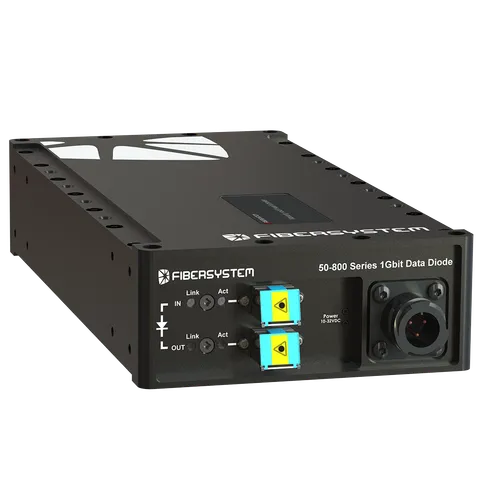
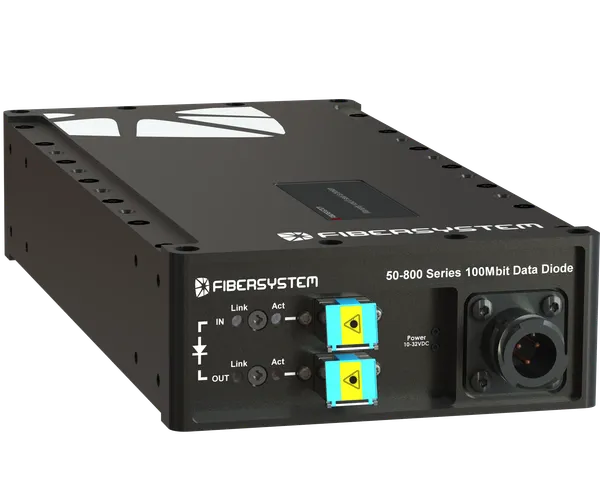
Fibersystem’s rugged products are protected to MIL-STD 461F with RE102 at Navy Mobile and Army levels, and the CS and RS suites for army platforms. The exact methods are listed on each rugged product page, for example the Data Diode Rugged 1 Gbit MM.
Why the levels are named after platforms
RE102 limits differ for “Navy Mobile”, “Army” and other platform categories, and the reason is practical rather than bureaucratic. A ship is a metal enclosure full of sensitive receivers where reflections make everything worse. An army vehicle has different antennas at different distances. A fixed ground installation is more forgiving.
Specifying a level therefore means specifying an environment, not a quality grade. Equipment qualified for one platform is not automatically suitable for another, and “MIL-STD 461 compliant” without a platform and a method list does not answer the question an integrator is asking.
EMC and EMSEC are not the same thing
This distinction causes genuine confusion in procurement, and the two requirements are sometimes written as if either would satisfy the other.
EMC asks whether emissions are low enough not to disturb other equipment. It is a functional concern: the radio must work, the radar must not be blinded, the device must not be upset by either.
EMSEC asks whether emissions carry reconstructable information. It is a confidentiality concern, verified against SDIP-27, and its limits are set by what an adversary could recover rather than by what would disturb a neighbouring receiver.
A device can pass MIL-STD 461 comfortably and still leak information usable to someone with a receiver and patience, because the emission that matters for EMSEC may sit well below the level that matters for EMC. The reverse also happens: a TEMPEST-certified device is not thereby qualified for a vehicle platform, because nobody tested its susceptibility to a radar.
If both matter – and in a deployed classified system they usually do – both belong in the requirement, separately named.
Three sides of one discipline
- MIL-STD 810G proves the device survives the physical environment.
- MIL-STD 461 proves it coexists in the electromagnetic environment.
- EMSEC and TEMPEST prove its emissions carry nothing worth intercepting.
The engineering overlaps substantially. Shielding, filtering, controlled cable entry and careful grounding serve all three, which is why a manufacturer that masters one tends to master the others — and why retrofitting any of them onto a finished design tends to fail. All three are designed in from the start at Fibersystem’s in-house development in Stockholm.
What to ask a supplier
Which platform levels? RE102 at Navy Mobile is a different claim from RE102 at fixed ground.
Which susceptibility methods, at which field strength? RS103 at 20 V/m and RS103 at 200 V/m are not the same test.
Was the unit tested as it ships? With its actual cables, its actual power supply and its actual enclosure — EMC results are properties of an installed configuration, not of a circuit board.
Is a test report available? For defence procurement it usually should be, and it is a normal part of a tender response.