Pattern DD-A
Backup over a data diode
Sizing against the backup window, the role of the middleware, and why restoring is the hard direction.
- Area
- Data diodes
- Environments
- 1
- Products used
- 6
How it is built
- One-way path
- Data path
- Path that does not exist
How it works
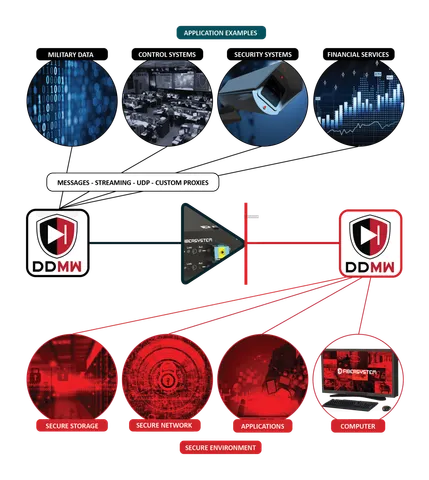
The backup server stays where it is and keeps doing its job. What changes is the destination: instead of writing to storage it can read back from, it hands the result to the middleware’s sender node. The sender terminates the protocol, sends the payload as a one-way stream across the diode, and the receiver rebuilds the files and verifies the hash before writing them to the store.
The hard part is sizing
The receiving side cannot ask the sender to slow down. Send more than the link carries and the excess is lost — and the sender does not notice. For telemetry a lost sample is noise; for backup a lost file is a broken restore that surfaces when it is needed.
Size for the peak, not the average. The largest single job, divided by the actual window in seconds, plus the middleware’s redundancy, plus margin for interleaved jobs — then compare against 1 Gbit, which is the ceiling in this catalogue. A production network with several terabytes of nightly change does not fit across a 1 Gbit link however well the flow is built. Write that into the study rather than discovering it at commissioning.
Verification without an acknowledgement
Nothing comes back, so verification has to be built as an independent flow out of the backup domain to a third place — not as a return path. Three mechanisms, in the order they should be introduced: a manifest per job listing what was sent, a heartbeat that alarms when it stops, and a periodic test restore. A pattern without the third is not verified. It is monitored.
In the catalogue
Equipment from the catalogue
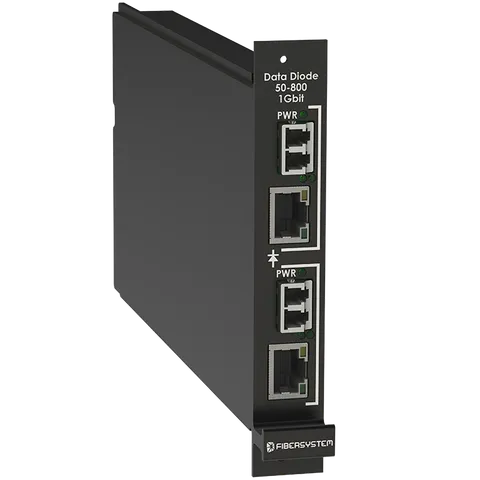
TEMPEST Level A · RÖS U1
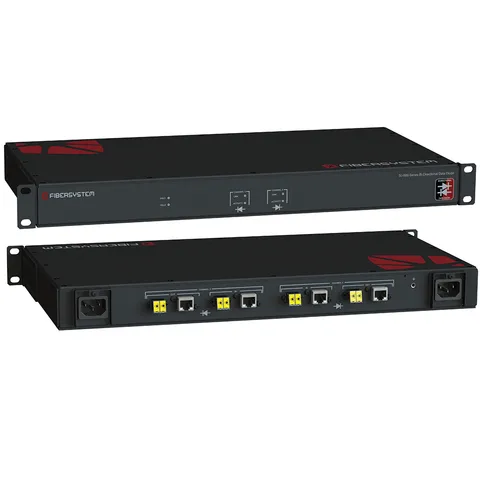
Data Diode Secure 1 Gbit MM TEMPEST
- Data rate
- 1 Gbps
- Wavelength
- Multimode 850 nm
- Input, LC
- 1000 BaseSX
Product no 60-00-7303
Standard
Data Diode Secure 1 Gbit SM
- Data rate
- 1 Gbps
- Wavelength
- Singlemode 1310 nm
- Input, LC
- 1000 BaseLX
Product no 60-00-8362

Next step
Designing something that is not here?
Send us the constraints. We build from idea to certified end product, and most of what is in the catalogue started that way.
Verified credentials
All certifications- Swedish Armed ForcesM-numbered equipmentMain supplier, Total Defence

- Government of SwedenSupplier to Swedish authoritiesPolice · FMV · FOI

- NATOCertified TEMPEST supplierSDIP-27 · Level A & B

- ISO 9001 14001ISO certifiedQuality & environmentDownload certificate (JPG)
- SOFFDefence industry memberExport control frameworks

- Made in SwedenDesigned & built in StockholmSecure supply chain